
Ex Parte Reexamination: When It Is the Right Call — and How to Make It Count
The narrative that ex parte reexamination is a limited fallback misses the cases where it is not just adequate — but strategically superior. Here is when to choose it and how to maximize the search that determines whether it succeeds.
The conventional framing in IP litigation circles has hardened into something close to consensus: ex parte reexamination (EPRx) is what you file when inter partes review is unavailable, too expensive, or too risky. A fallback mechanism. A pressure tactic. A tool with structural limitations that make it inherently inferior to IPR.
That framing is incomplete — and in certain factual and strategic contexts, it is outright wrong.
There are specific situations where ex parte reexamination is not merely adequate. It is the better vehicle. And in those situations, the quality of the prior art search is not just important — it is everything. The SNQ threshold sounds permissive, but the USPTO’s grant rate on requests tells a different story: examiners reject poorly supported requests. When they do, the requester has spent time, money, and lost the element of surprise, with nothing to show for it.
This post is about the cases where EPRx is the right answer — and what a search must contain to make that answer land.
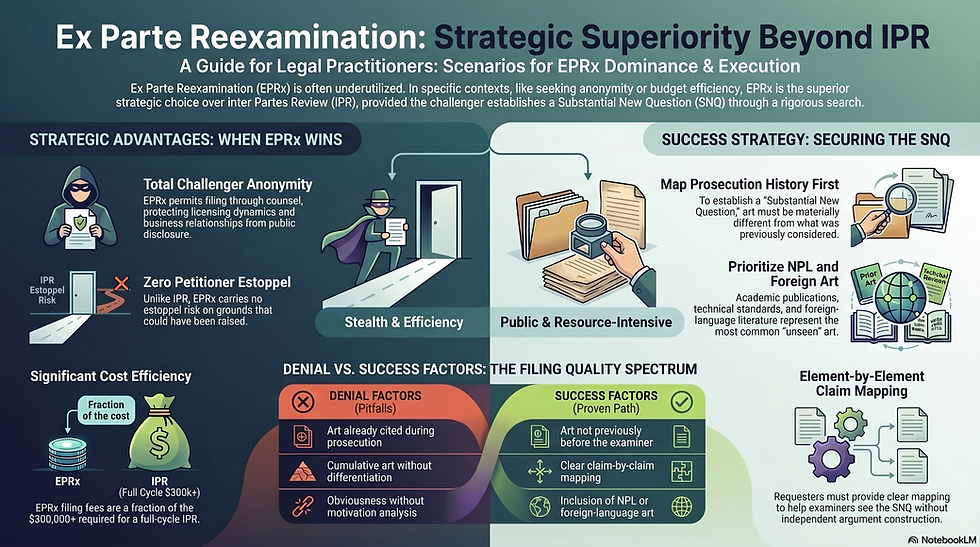
The five scenarios where ex parte outperforms IPR
These are not edge cases. Practitioners encounter them regularly — and in each one, the structural features of EPRx that are framed as weaknesses become, in context, its defining advantages.
Scenario 1: The anonymous challenger
EPRx permits anonymous filing through counsel. IPR does not. Where the requester’s identity would affect licensing dynamics, litigation posture, or business relationships — anonymity is not a minor convenience. It is the reason to choose this route.
Scenario 2: Post-IPR estoppel exposure
A party that has already filed an IPR — or is in privy with one — faces estoppel risk on grounds that were raised or reasonably could have been raised. EPRx carries no petitioner estoppel. For parties with downstream litigation risk, this is a material difference.
Scenario 3: The single strong reference
IPR requires a threshold showing across multiple claims with element-by-element mapping. When the prior art situation is dominated by one anticipatory reference — not a combination, not a mosaic — EPRx is structurally better suited to place that reference squarely before an examiner.
Scenario 4: Pre-litigation settlement leverage
An EPRx filing, particularly one that the USPTO grants, creates immediate uncertainty in a patent’s validity. For parties in licensing negotiations or early-stage dispute resolution, a pending reexamination shifts leverage before any litigation commences.
Scenario 5: Budget-constrained challengers
Full-cycle IPR — from petition through oral argument — routinely exceeds $300,000 per patent. EPRx filing fees are a fraction of that. For parties with real invalidity positions but constrained resources, EPRx may be the only viable path to actually using them.
In each of these scenarios, the structural features critics cite as EPRx’s limitations — no cross-examination, no adversarial hearing, patent owner flexibility to amend — are either irrelevant to the strategic objective, or manageable through search quality and framing.
What the SNQ standard actually requires
The Substantial New Question of Patentability standard is routinely described as a low bar. It is lower than the IPR threshold, but “substantial” in the statutory sense is doing real work that practitioners sometimes underestimate.
A substantial new question is not simply prior art that the applicant did not cite during prosecution. It is prior art that — from the perspective of a reasonable examiner — raises a substantial question about whether the claim should have issued. Two things follow from this.
First, the reference must actually be new to the examination record in a meaningful sense. Prior art that was considered by the examiner, or that is merely cumulative of what was considered, will not qualify. This makes search thoroughness a precondition — not just a quality preference — because the requester must identify art that genuinely was not before the examiner in a material way.
Second, the framing of how the reference maps to the claims matters as much as the reference itself. The USPTO has denied requests where strong prior art was poorly mapped or presented without the claim-level analysis that allows an examiner to see the SNQ without having to construct the argument independently.
What gets requests denied | What grants requests |
References already cited during prosecution | Art not previously before the examiner |
Cumulative art without differentiation | Clear claim-by-claim mapping in the request |
Missing element-by-element mapping | Anticipation or strong primary obviousness reference |
Weak or partial anticipation presented as full | Non-patent literature where patent art is thin |
Obviousness without motivation analysis | Foreign-language art that prosecution missed |
How to build a search that gives EPRx its best chance
A search scoped for EPRx is not simply an invalidity search with a different label. The strategic constraints of the proceeding — no petitioner participation after filing, no ability to supplement the record, no cross-examination — mean that the search must be complete before the request is filed. There is no discovery phase to fill gaps.
SOURCE COVERAGE
1. Map the prosecution history first. Every reference the examiner considered is off the table for SNQ purposes unless a material distinction can be drawn. The search must begin by excluding what was already before the Office — not after.
2. Prioritize non-patent literature. NPL is structurally underrepresented in most prosecution histories because applicants are not required to conduct comprehensive NPL searches. Academic publications, conference proceedings, technical standards, and product manuals are frequently the source of the strongest reexamination references.
3. Include foreign-language prior art systematically. Japanese, German, and Korean technical literature published before the priority date represents a category that most prosecution searches do not reach. Art that the examiner demonstrably never saw — because it required translation and specialized database access — satisfies the “new to the examiner” requirement at a structural level.
4. Search across the full claim scope, not just the independent claims. EPRx can be directed at any claim. A request limited to independent claims leaves dependent claims intact and invites claim amendment that narrows scope while preserving the patent. A search that finds prior art for dependent claims as well creates a stronger record and limits the patent owner’s amendment options.
REPORT FRAMING
The search deliverable for EPRx should not look like a standard invalidity report. It should be structured so that the claim mapping can move directly into the request with minimal rework. That means element-by-element analysis for each identified reference, explicit distinction from prosecution history art, and a clear statement of how each reference raises an SNQ against specific claims — not just a summary of what was found.
A request that forces the examiner to construct the SNQ argument from raw references is a request that may be denied not on the merits of the art, but on the clarity of its presentation. The search report and the request document should be built in parallel.
The claim amendment question
The concern most commonly raised about EPRx is that patent owners can amend claims with relative flexibility — narrowing scope in ways that may preserve the patent while limiting its commercial coverage. This is a real feature of the proceeding. But its practical significance depends on what the challenger’s objective is.
If the objective is total invalidation, EPRx is genuinely limited. But total invalidation is not the only valuable outcome. A claim amendment that narrows the asserted scope — removing coverage of a defendant’s product or method — is litigation-terminating even if the patent survives. Pre-litigation challengers seeking to clear a specific freedom-to-operate concern may find that an EPRx grant, even one that results in narrowed claims, fully resolves the commercial problem.
The amendment risk is also mitigated by search breadth. A requester with strong prior art across dependent claims forces narrowing options into a space where further amendments either introduce prosecution history estoppel problems or move outside the patent owner’s commercial core. A thorough search is, in this sense, the primary tool for controlling the amendment dynamic.
The broader context: why EPRx matters more now
The IPR landscape has shifted in ways that are well-documented: institution rates declining, Fintiv discretionary denials creating procedural uncertainty, costs continuing to rise. These changes have pushed more practitioners toward EPRx not because it has improved, but because the alternative has become more expensive and less predictable.
The result is that more EPRx requests are being filed by parties who understand its limitations but are choosing it deliberately for the reasons described above — and more requests are being filed by parties who understand it poorly and are treating it as a cheap substitute for an IPR they cannot afford. The latter category fails at high rates.
The difference between the two is almost entirely in the quality and framing of the prior art search.
A request built on a thorough, multi-source search — with clean prosecution history mapping, strong non-patent literature, foreign-language coverage, and request-ready claim analysis — succeeds. A request built on a repurposed invalidity search with a changed cover page does not.
Request a scoping conversation
If you are evaluating EPRx for a current matter, 3AIP can assess the prior art landscape for the target patent, map what was before the examiner, and identify whether a search is likely to surface material that would support a grant. No commitment required.
Contact: Umesh@3aip.com | www.3aip.com


