How PTAB Uncertainty Is Rewriting Patent Strategy in 2026
For nearly a decade, the Patent Trial and Appeal Board (PTAB) served as the most reliable early‑stage invalidity mechanism in U.S. patent litigation. At its peak, institution rates exceeded 85% (2013–2015 USPTO data), and defendants could often secure a stay while the Board evaluated the challenged claims.
That landscape has changed.
Institution rates have fallen to approximately 58–63% (2023–2024), and discretionary denials—especially under the Fintiv framework—have introduced a level of uncertainty that fundamentally alters litigation strategy. While PTAB remains an important venue, it is no longer the near‑automatic early checkpoint it once was. As a result, validity disputes are increasingly returning to the District Courts, and the intrinsic strength of the patent is once again the central determinant of leverage.

Below are the five strategic shifts now shaping risk, valuation, and litigation planning.
1. PTAB Is No Longer the Reliable Early Invalidity Tool
The Board continues to play a major role in patent disputes, but its predictability has diminished.
Key Data Points
Institution rates dropped from ~87% (2014) to ~63% (2024).
Discretionary denials citing Fintiv factors increased significantly, particularly in NPE‑initiated cases.
In 2023, over 40% of denials referenced parallel District Court timelines.
The practical effect is clear: defendants can no longer assume that an IPR will be instituted or that a stay will follow.
Litigator Impact
This shift forces defendants to prepare for full‑scale District Court litigation from day one, rather than relying on PTAB to intercept the case early.
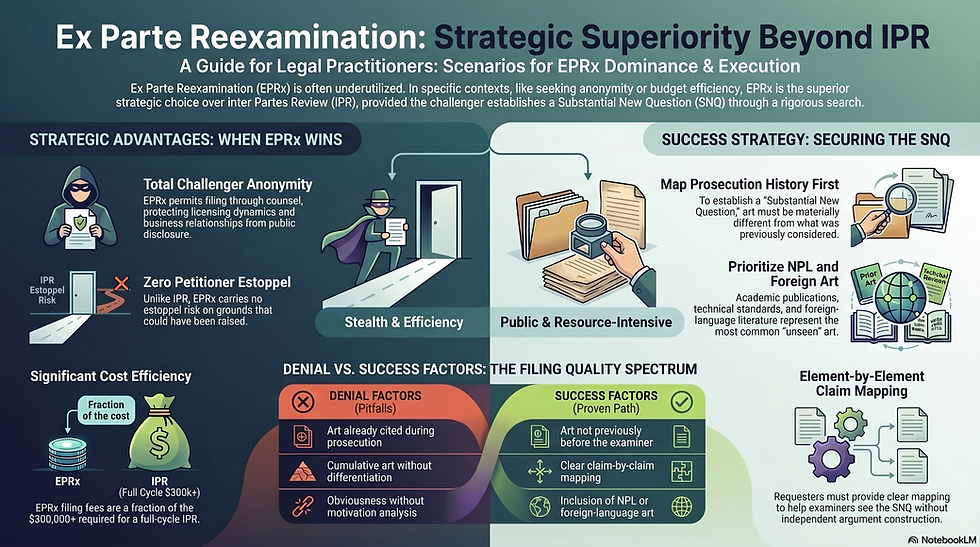
2. Ex Parte Reexamination Is Rising, but It Is Not a Substitute
With IPR institution becoming less predictable, ex parte reexamination filings have increased by 20–25% since 2021. But reexam remains a limited tool.
Structural Limitations
No adversarial hearing
No cross‑examination
No petitioner participation after filing
Patent owners can amend claims with relative flexibility
Reexam can create background pressure, but it rarely shifts the core litigation trajectory.
Litigator Impact
Reexam may influence settlement dynamics, but it does not provide the tactical leverage or evidentiary control of an IPR.
3. Validity Battles Are Returning to the Courtroom
As PTAB relief becomes less accessible, District Courts are once again the primary venue for validity disputes.
Key Differences Litigators Must Account For
Burden of proof:
PTAB: preponderance
District Court: clear and convincing
Decision‑makers:
PTAB: technically trained APJs
District Court: judges and juries
Procedural environment:
PTAB: limited discovery, expert‑to‑expert
District Court: Daubert challenges, evidentiary rules, narrative‑driven persuasion
Arguments that succeed before APJs may not resonate with a jury unfamiliar with technical nuance.
Litigator Impact
Invalidity positions must be trial‑ready, not PTAB‑ready. The litigation team must assume the case will proceed to a full trial unless proven otherwise.
4. Reduced Administrative Risk Is Increasing Patent Value
As PTAB becomes less predictable, the risk‑adjusted value of issued patents is rising.
Supporting Indicators
Unified Patents reports a steady decline in IPR filings since 2020.
Litigation finance firms are assigning higher valuations to assets with low PTAB exposure.
Licensing negotiations increasingly factor in reduced administrative invalidation risk.
When the likelihood of an early administrative challenge decreases, the resilience of a patent increases its leverage in:
Licensing
Settlement negotiations
Damages modeling
Portfolio valuation
Litigator Impact
A strong patent is now defined not only by its claim drafting but by its ability to withstand District Court scrutiny without the expectation of PTAB intervention.
5. Litigation‑Grade “PTAB‑Proofing” Is Now Essential
In this environment, the intrinsic strength of the patent matters more than the venue in which it is challenged. This requires front‑loaded, litigation‑caliber analysis long before assertion.
What Modern PTAB‑Proofing Requires
Comprehensive global prior art searches (including NPL and foreign‑language sources)
Claim‑construction‑aligned invalidity modeling
Prosecution‑history stress‑testing
Anticipation and obviousness mapping
Expert‑ready evidentiary frameworks
Because PTAB can no longer be relied upon to “correct” weak patents mid‑litigation, the search and analysis phase must be deeper, broader, and more adversarial in mindset.
Litigator Impact
Invalidity strategy must be built as if the case will proceed to trial—because increasingly, it will.
Conclusion: A New Litigation Reality
The reduced predictability of PTAB has shifted the center of gravity back to the courtroom and back to the patent itself. In this environment:
Weak portfolios create exposure
Strong, well‑researched portfolios create leverage
Trial‑ready invalidity positions are mandatory
Front‑loaded analytics are no longer optional
The question for litigators is no longer whether PTAB will intervene.
It is whether the patent—and the invalidity case—can withstand the full rigor of District Court litigation.
Get Your Free Prior Art Search Quote in 60 Seconds
Share your requirements - get a tailored quote instantly.
P.S. Clients see 20-25% cost savings on the first project. Start yours now.